LEADERSHIP: The Cabinet
GOVERNMENT: Parliamentary
IDEOLOGY: Democratic
STATE: Liberal
MAGIC: Monitored, civic
SECTS: Parties
LOCATION: Westminster
Once known as the Parliamentarians, and before that, the British government, the Traditionalists are the last remnants of the old order, more or less. Securing the streets with the consolidated agents of the state creating a single civil service dedicated to the oversight of production, the distribution of clothes, food, water and medicine, as well as maintaining peace and order, securing the borders and catching criminals and insurgents. Only the Survivalists have a potential claim to a higher surviving population than them, and no single unified faction holds anywhere near as much territory, less so of strategic or administrative importance.
The New Parliament leads the Traditionalists, composed of the House, made up of sixty representatives that pass legislation with either 31 or 41 votes depending on what is being passed, along with the Cabinet, 20 people who collectively make up the ‘government’. Every six months, a community can call its House member to a vote against any candidate or candidates, and every two years the parties in the House work to put forward a proposal for the Cabinet, which is then voted on by the general public. The current leading parties are the New London Party (Londoners), a broad coalition of primarily pre-war politicians and integrationist kith; the Red Guard (Reds), radical cadres that stormed the government in the aftermath of the collapse and campaign for the rights of workers; and the Domus Advocacy Group (DAG), whose interests lie in preserving the culture of Domus and ensuring the safety of kith. All human-centric and anti-magic parties were expelled following the move to the Cabinet system.
Maintaining this order is the Civil Guard. They are a collection of all government institutions merged into a single, stratified force with direct control by the Cabinet, and originally by the Prime Minister. Each officer upon the merge was given a rank befitting their role (typically for active roles, the military retained their rank, and guards and police were given one rank below, whereas for civilian roles the internal service worked it out on their own), though maintained their uniform due to resource scarcity. They are responsible for the distribution of work orders, housing disputes, policing, management of food and medical centres, as well as scouting and border defence. Since the Third Cabinet, dominated by the Reds, each member is subject to right of recall should their position be abused.
The primary guiding force of the Traditionalists is one of guestright. In many senses, those of Domus are guests on Earth, and arguably so is their magic. However, a good host is accommodating of their guests wants and needs, so long as that guest is thankful and respectful. To that end, the Traditionalists aim to maintain the structures of Earth in a way that includes all people now resident, tweaking Earth to better suit kith rather than ripping it up entirely. ‘Tradition’ does not refer strictly to conservatism, but rather to the traditions of Earth that were worth keeping, and also the traditions of Domus that its people can share and adapt to this new environment.
History and Geography
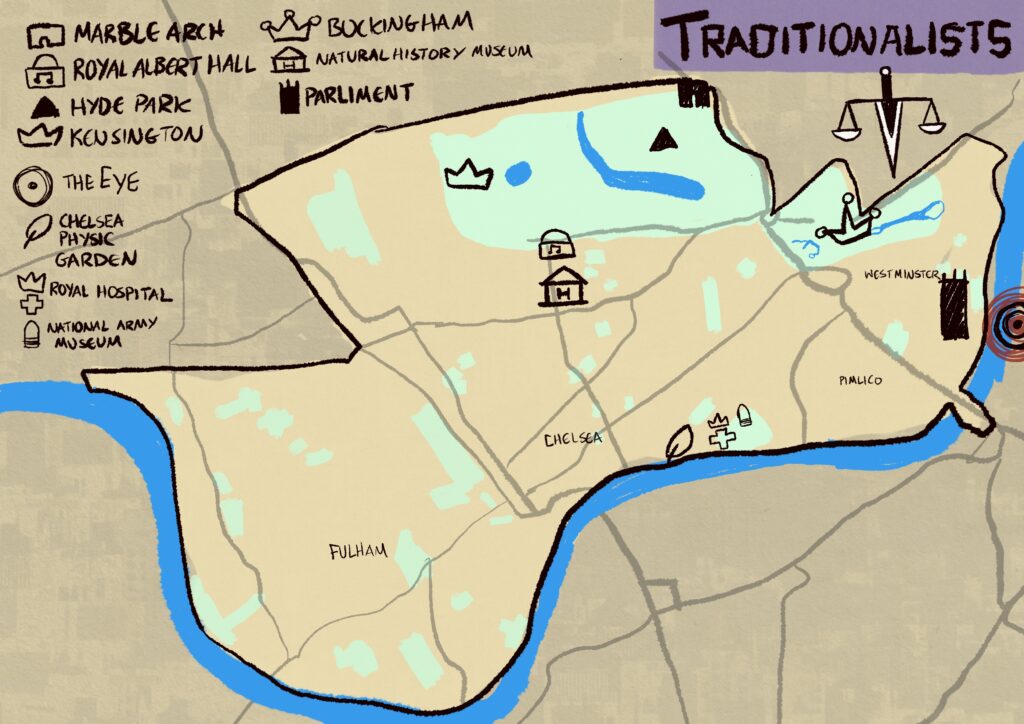
Following the first bombing, the Government, under Prime Minister Kowalczyk and the AUP, attempted to maintain order. They reached out, despite their misgivings, first to the Erudites and Pilgrims, but found both had set up their own militias and gathered the population. Before negotiations could happen, the second strike hit, and the government found itself severely damaged as well as cut off, though it had managed to successfully muster the forces to secure a wide area around Westminster, though not without losses. Radical groups who had headquarters and centres in the vicinity quickly appealed to, then attempted to take over the government, and without sufficient defence on the government side, or forces on the radicals, they were forced to come to an agreement. Out of this agreement was born the Parliamentarians, who worked to recreate representative democracy, though now more fringe organisations, from socialists to action groups and even charities and local groups were able to put forward their own representatives. Parties soon emerged, and as did the consolidation of the Civil Guard, everything under the direction of the Prime Minister, who had survived the attack, if not unscathed. Housing was quickly provided, even turning Buckingham palace into a shelter and hospital, which eventually became a permanent residence for essential workers and those in need of care.
Magical experts were brought in to help the restructuring of society, and the Guard began to create work lists for people to apply to in exchange for extra rations. Soon enough, the Parliamentarians had a robust internal system.
After the AVs reach Britain and the first reports from scouts come in, the Prime Minister becomes paranoid, and orders the Guard to round up anyone who might be infected, meaning all other vampires as well as some lycans. The Guard refuses, and the PM is forced to stand down in shame, and the AUP splinters without her. She completely disappears from public life, and is not seen again, perhaps wearing bandages over her facial wounds and nondescript clothes, or perhaps wandering off into the ruins. Arthur Woolfe, an independent, is elected in her stead, promising a greater more transparent democracy. He institutes the Cabinet system, making the PM’s role obsolete, and two years later the Third Cabinet comes to power, and makes further changes to the Guard. During this ‘Red Cabinet’, fringe groups attack greenhouses for their use of ‘corrupting’ magic that could turn anyone, citing the war, as well as the Thames monsters as proof. The group calls themselves ‘Purists’ and ‘Uncorrupted’, though are quickly linked to the Restorationist party. There is fighting, and though short, it is bloody, and the Purists are exiled, along with their supporters.
In shock, the Parliamentarians realise that they have changed significantly from the old world, but that this is for the best. Accepting that the world itself had changed, the Cabinet elected to rename the Parliamentarians to the Traditionalists, to break away from their former comrades and begin anew, as a place all people can find home, security, and safety.
Approach to Magic
Magic has always made people feel uneasy, and the Traditionalists understand this. What they also understand is that magic caused the crisis in London, and only magic can readily solve it. To that end, magic is used sparingly, but to great effect. Skyscrapers have become magical greenhouses, magic is used to speed up the treatment of rapid and dangerous conditions, and though much of the aid to kith is outsourced to local chapters, the central government does its best to make sure they are adequately provided for.
Look and Feel
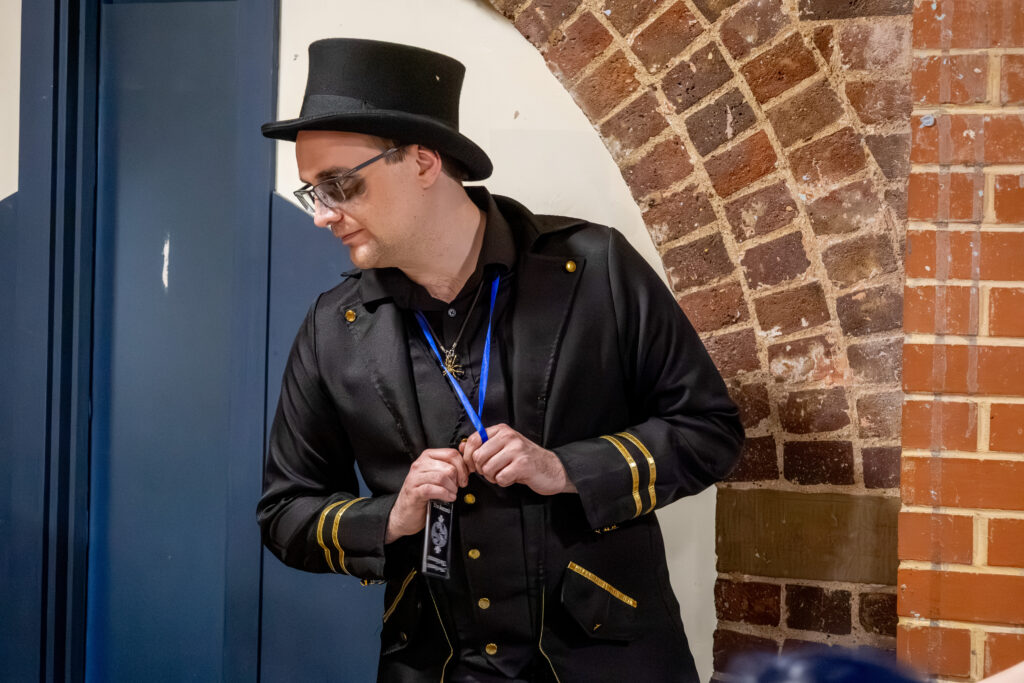
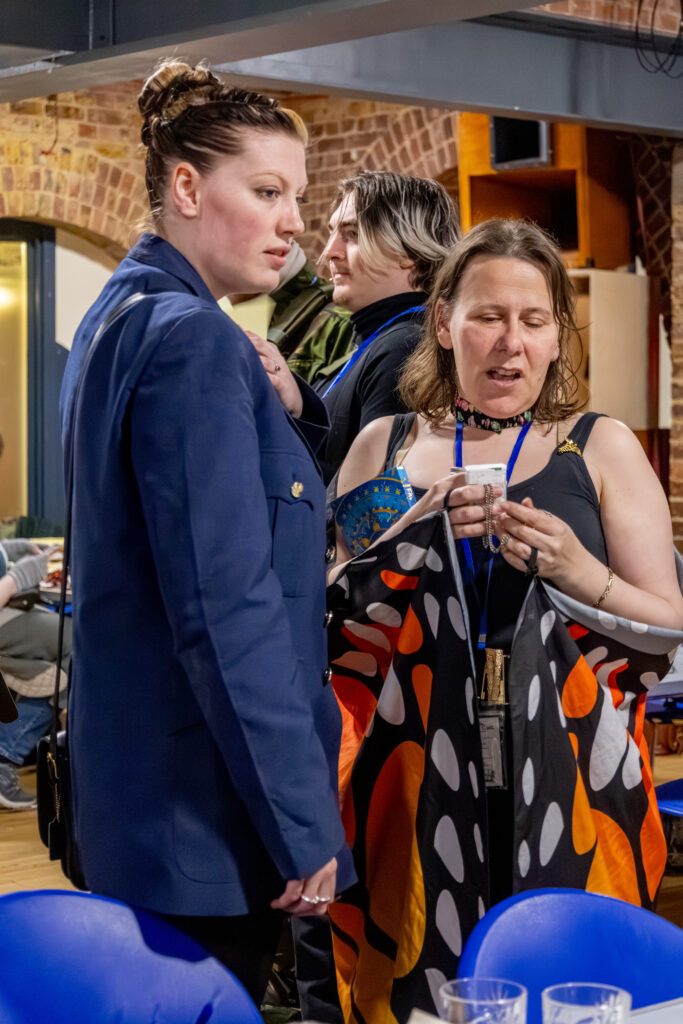
A day-to-day life looks as close to the modern day as possible. The work may be different, defending the gates, sewing, farming, and civil administration over working for profit, but at the end of the day, people get up in the morning, go to a structured job, and go home to a house or (more commonly) apartment or house share. There is a government, there is a policing force with training standards, and a person to go to if something is wrong. People wear new, plain clothes, easily spun shirts, skirts, and trousers, or they wear pre-war clothes, with a preference for business-casual. The exception to the rule is the Civil Guard, who wear their old uniforms, or pre-war military surplus, though as time goes on a new uniform is developing – a white shirt, and navy blue waistcoat, trousers, and overcoat, complete with black polished shoes, with pips on the collar of the shirt and the shoulders of the coat to indicate rank. These uniforms are still relatively rare, and old ones are still fine. Those seeking protection from the sun ought to wear heavy garments, and those with wounds or mutations, especially burns, tend to cover them with simple bandages worn under the clothes.
Stereotypes
- Survivalists – Above all, they’re in need of guidance, structure. A society isn’t built on warring sects, but on cooperation and discussion.
- Evolvers – To put it simply, they’re chucking the baby out with the bathwater, trying to start a new world by throwing experiments against the wall and seeing what sticks, but who cares for them when they crash? We must, it seems.
- Pilgrims – In the time before the war, they gave people hope. There’s still a sliver in there, before the power got to them, yet the fact that man cannot live on bread alone does not negate the need for bread. Still, when they come back, we will accept them with open arms.
- Erudites – I don’t know if they could have saved us or not, but they could have done more. A coup was the wrong way.
- Purists – They are proof of our shame. Proof that we must adapt to survive.
Notable NPCs
Comrade-Speaker Charlotte Byrne
Human, 36 years old
Four elections ago, Charlotte Byrne was appointed Speaker of the House by the Red Cabinet for a seemingly impossible ability to hold together disparate factions without them splintering. This skill transferred to Parliament where, so far, there have been zero assaults on the Commons floor. The interim DAG parliament chose to keep her in place, and the most recent two were in order a Londoner-Red coalition, and now a second Red Parliament. In that light, she has adopted the term “comrade-Speaker” as her in-use title. Even the most conservative among the ministers find her charming, personable, and easy to work with. The one exception is a single independent who somehow keeps getting elected, Jacob Taylor, who insists that the Calamity was a hoax for radicals to gain power.
Charlotte’s career began as an advocate for workers during her student days, and swiftly evolved into a life of politics and struggle. She bears the scars from the scuffle during the Collapse, having been one of the members who attempted to storm Parliament.
Cabinet Minister Arthur Woolfe
Dawn Vampire (turned during calamity), 57 years old
Minister for the Cabinet of the Parliament of New London, Arthur Woolfe is a highly respected figure. He was the last Prime Minister of the Traditionalists, and therefore by convention the last Prime Minister of Britain after her deposed the former PM Anna Kowalczyk and removed nearly all powers of the position. Technically, he has never been replaced, and as he is continuously elected to the Cabinet in recognition of his years of diligent service, he could theoretically claim the title. As he never will, nobody has paid much mind to the minor legislative details. Woolfe is often given oversight over the Civil Guard, and is responsible for the instating of the new ration book system which the Guard are currently rolling out. His love for his community is obvious, as is its love for him. Despite his old-world background, even Domus kith can find something to relate to, as even though his turning was not willing, he holds no grudges, and has simply continued with his life, as dedicated to good order and proper manners as ever.
Shiver Who Lifts The Flock
Lycan (Crow), 40 years old.
Shiver Who Lifts The Flock came over as a refugee, as she puts it. She believes strongly in the Traditionalist view of guesthood. She has no want to join Parliament, but still has her name known across the territory, having set up food aid in the early hours of the post-collapse. It’s possible that without her, and those like her, the Traditionalists would not have been truly formed, let alone survived. To all who know her, she is a shining example of what a Traditionalist ought to be. Dedicated, loyal, helpful, and respectful of all who are respectful of others.