LEADERSHIP: Council of Authority
GOVERNMENT: Council of Faith
IDEOLOGY: Partly Theocratic
STATE: Communal
MAGIC: Rampant
SECTS: Schisms
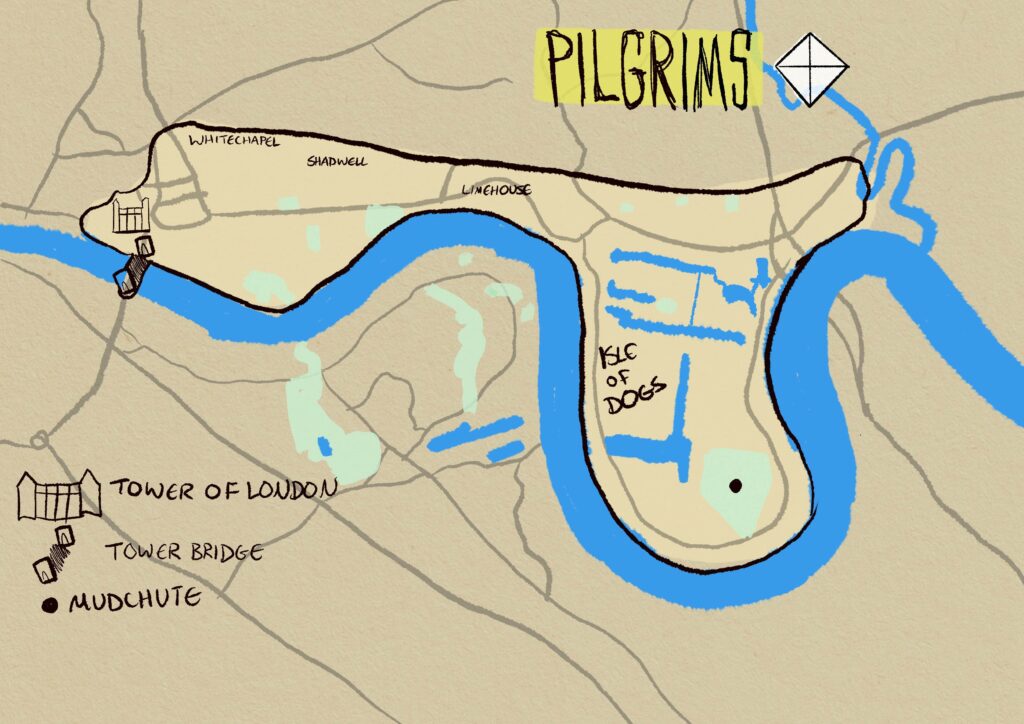
LOCATION: Canary Wharf and Tower of London

The location of the largest portal in greater London is called the Tower Crossing and there lies the central shrine of the Pilgrims. The Pilgrims believe first and foremost in the flow of the world, and of its magic, as an unchangeable fact of reality, and understand that magic moves with its own divine will. They rebuke the madness of the Erudites, and all who claim to control the will of the divine with mere mortal hands. The world may have been destroyed, but that is no reason to lose ourselves. We must remake, they say, remake, repurpose, and improve. Only by diligent effort to maintain with what is, and trust and believe that what is needed shall be provided, will all kin and kith endure, and even prosper.
The Pilgrims are an open, but not exactly equal, society. All people are welcome, are fed, and given the basics to survive, but only those with the will to contribute, who can study the philosophies and canticles of magic will ever truly understand the depths of the Pilgrims’ mission. Only they know the truth – the world can be restored, and though there are many tributaries, there is one ultimate path to that salvation. Two chambers lead the Pilgrims. The first is the Council of Authority operating out of Canary Wharf, who nominally control civil matters. They are responsible for the census, for food distribution, peacekeeping, and other daily tasks. Elected via ballot every six months, twenty-four delegates from across the Pilgrims’ territory are the official face of the faction. Then, the Council of Faith, sequestered in the Tower of London. Originally a collection of religious authorities from both Earth and Domus, they have come together to agree that the will of the divine has manifested in magic. Whoever was ‘right’ before now is inconsequential, perhaps it matters and they may continue their rituals in private, but for action going forward, magic is here, and we can all see it. Arcane clergy, shrouded in ritual and mystery, lead ceremonies to the public, and announce the direction of the faction, a direction the CoA always follows. Far from being sinister, however, they are revered and trusted. It is the Council of Faith that put forward the Edict of Cooperation, which has been the basis of Pilgrim communal living since the fall of London. People in this territory might have difficult lives, but they are happy lives, with many who grew into adulthood in the new world choosing to provide their service to their people by studying under the clerics both how to perform magic and how to do so safely, as well as providing guidance to their community as they in turn are guided into the gentle hand of the will of the arcane.
History and Geography
After initial research into magic revealed a ritualistic and difficult to codify ‘give and take’, various religious institutions were accepted to give their perspectives. After the isolation of Britain in 2008, a coalition formed to better understand the nature of magic. By the time of the collapse, however, it had splintered into those who sought to exploit magic and turn it to mortal ends, and those who saw magic primarily as a motive force. Though by no means a clear division, the more spiritual side would align with the latter. As time passed, the two sides of the divide their identities crystallised.
The Pilgrims of the Will, as they called themselves, attracted a great number of theological scholars and religious leaders, snowballing into their becoming the (only available in isolation) orthodoxy in the approach to understanding the will of magic through the lens of old world spirituality. Over the years, they managed to build a place of worship around Tower Bridge, the site of one of the major portals which became known as the Tower Crossing. The Crossing became a major centre for the community, and a place of sanctuary and rest for the people of Domus and all those influenced by magic, as well as a ritual site. The Crossing survived the collapse, and with it so did the Tower of London and the Bridge. Standing as a known community centre, survivors of the bombing flocked to the Crossing to seek sanctuary and guidance from the Pilgrims. Relief efforts down the Thames integrated a number of communities, but following the return of the AVs, the Pilgrims encouraged their residents to condense nearer to the safe areas, and away from the influence of other warring factions, and consolidated around the Tower and Canary Wharf, where a council of civilian administrators also came to prominence.
Approach to Magic
Magic in Pilgrim territory is not just accepted, but revered. Magic was given to this world, and has a clear design for it. Only by trusting that design, communing, and accepting the give and take will we be able to progress. A new world is not dawning, it has dawned, and if we want to see it before noon then we cannot push back against it. It was trying to hold back the tides that led to the destruction of Earth, and may well have been the destruction of Domus, too.
The magical ailments that afflict people, whether lunar madness, a craving for blood, or fallout-borne maladies are symptoms of the old world, and they are all tended to as part of the daily duties of the clerics.
Look and Feel
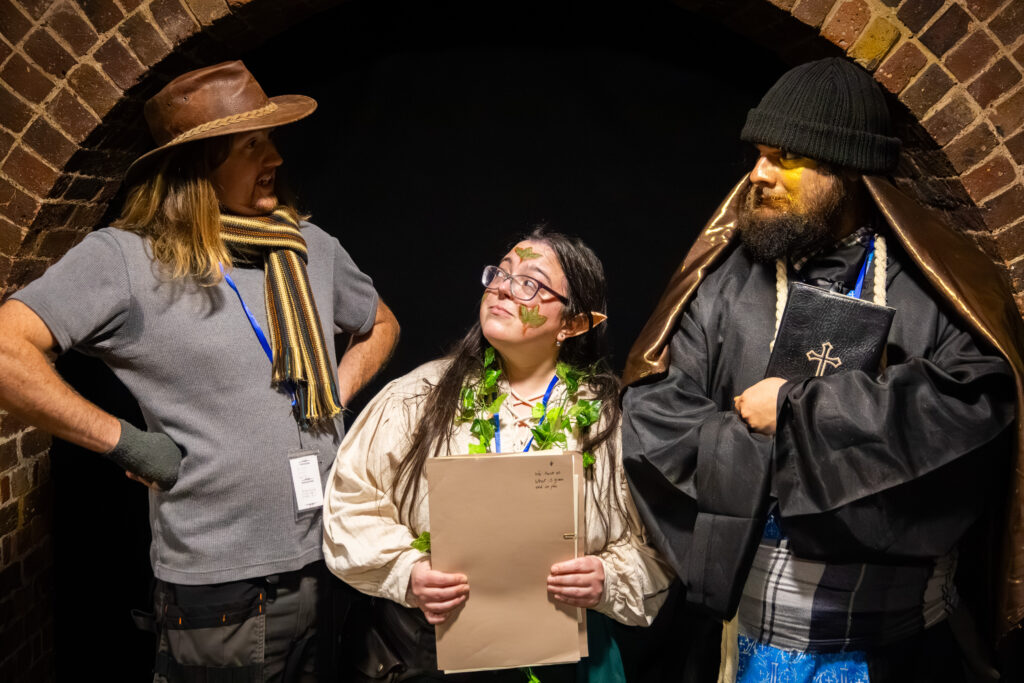
There is no need to be flashy, and one should always lead by example. To this end, laity dress is simple and sturdy, designed to function for a long while, through varied temperatures, and withstand field work, while also providing shelter from the harmful rays of the sun. The clergy, too, wear simple and practical garments, though more tailored to modesty and comfort. Simple grey or brown robes are not uncommon, but for day-to-day wear, dress such as traditional modest islamic clothing, or quaker plain dress is the basis for much of Pilgrim cleric fashion. For spiritual authorities, a hood or head covering is mandatory during the casting of rituals or the performing of ceremonies, and is encouraged otherwise, along with a piece of cloth with the four corners symbol pinned to their attire. This is an act of humility, to present oneself not as a mere individual, but a conduit for the world’s will, and an authority with the voice of the Pilgrims.
Stereotypes
- Survivalists – It’s admirable to accept this new world, but it’s slothful to do nothing with it.
- Evolvers – What madness, what folly, to plunge yourself into the unknown without a guide.
- Erudites – Our wayward kin; so blinded by their lust for power that they have forgotten why it all began.
- Traditionalists – Was it not their government, liberals and secularists, that plunged the world into war? What right have they to build again?
- Purists – Some crimes have only one answer: destruction.
Notable NPCs
Rabbi Elijah Dubinski
Human, 45 years old
There are many stories around Elijah’s past with few knowing which, or any, are true. The general understanding is that the opening of the portals in some way saved his life. This immediately fixed in his mind as an idea of Magic having a will and a motive and that it specifically saved him as its first act upon this new world. For years after the Exodus, he slowly began finding like-minded individuals and shared their ideals. Ulama Fadel was one of the first, becoming a beloved mentor figure. After she published the foundational text ‘Trusting in What Is Given’, Elijah gave a speech to assembled academics aggressively denouncing their reckless, and in some views cruel, magical research. This rapidly elevated him to the first spiritual head of the rapidly forming Pilgrim movement. Despite this, he is an incredibly down-to-earth man who is always happy to speak with and offer guidance to any Pilgrim no matter their origin or importance.
Ulama Aliyah Fadel (“Teta”)
Human, 81 years old
Aliyah Fadel, or Teta (meaning Grandmother) is – or was, depending on who you ask – an Ulama, a spiritual and legal authority. She engaged in furious debate both with secular academics and other Islamic scholars after the Exodus, and became central to a growing movement that believed magic was demonstrative of a divine will, that all those who claim to follow G-d’s truth ought to reflect upon. As a result, she wrote ‘Trusting in What Is Given’, a treatise on magic and faith which became the the first codification of what would become Pilgrim doctrine. From this, she gained the moniker as ‘grandmother’ of the faith, and for this she was expelled from the Campus District of London, and along with Rabbi Dubinksi, set up the first places of gathering and worship for the Pilgrims.
Ovierius of Fell
Dawn Vampire, 203 years old
Ovierius was a speaker, a votary, a preacher of the gentleness of magic in the old world. In the new, they have worked to find new leylines on Earth. They united early Pilgrims with the Kith of Domus, unifying the human/warlock ideas of the will with old Domus views. Their intervention was crucial in the creation of the first doctrines of the Pilgrims, for which they sit on the Council of Faith to this day as the highest authority of Domus affairs